WhatApp
+86-15522676451WhatApp
+86-15522676451
Installing a drainage system during the rainy season is an extremely challenging engineering task. Factors such as soil moisture variations from rainfall, unstable foundations, and tight deadlines make the choice of piping material critical. This article provides an in-depth analysis of the performance differences between corrugated pipes (typically referring to HDPE double-wall corrugated pipes) and PVC pipes (mainly UPVC pipes) in rainy season installation environments and offers scientific selection strategies for different scenarios.
I.Unique Challenges of Rainy Season Installation
Rainy season construction presents several unique challenges that directly impact the long-term performance of the piping system:
• Changing Soil Conditions: Persistent rainfall saturates soil, reducing its bearing capacity and increasing the risk of uneven settlement.
• Unstable Installation Foundations: Trenches are prone to water accumulation and sidewall collapse, making quality control of backfill material difficult.
• High Schedule Pressure: Frequent rainfall interrupts construction, necessitating rapid installation and immediate inspection.
• Short-Term Performance Demands: The system must withstand potential heavy rain tests immediately after installation.
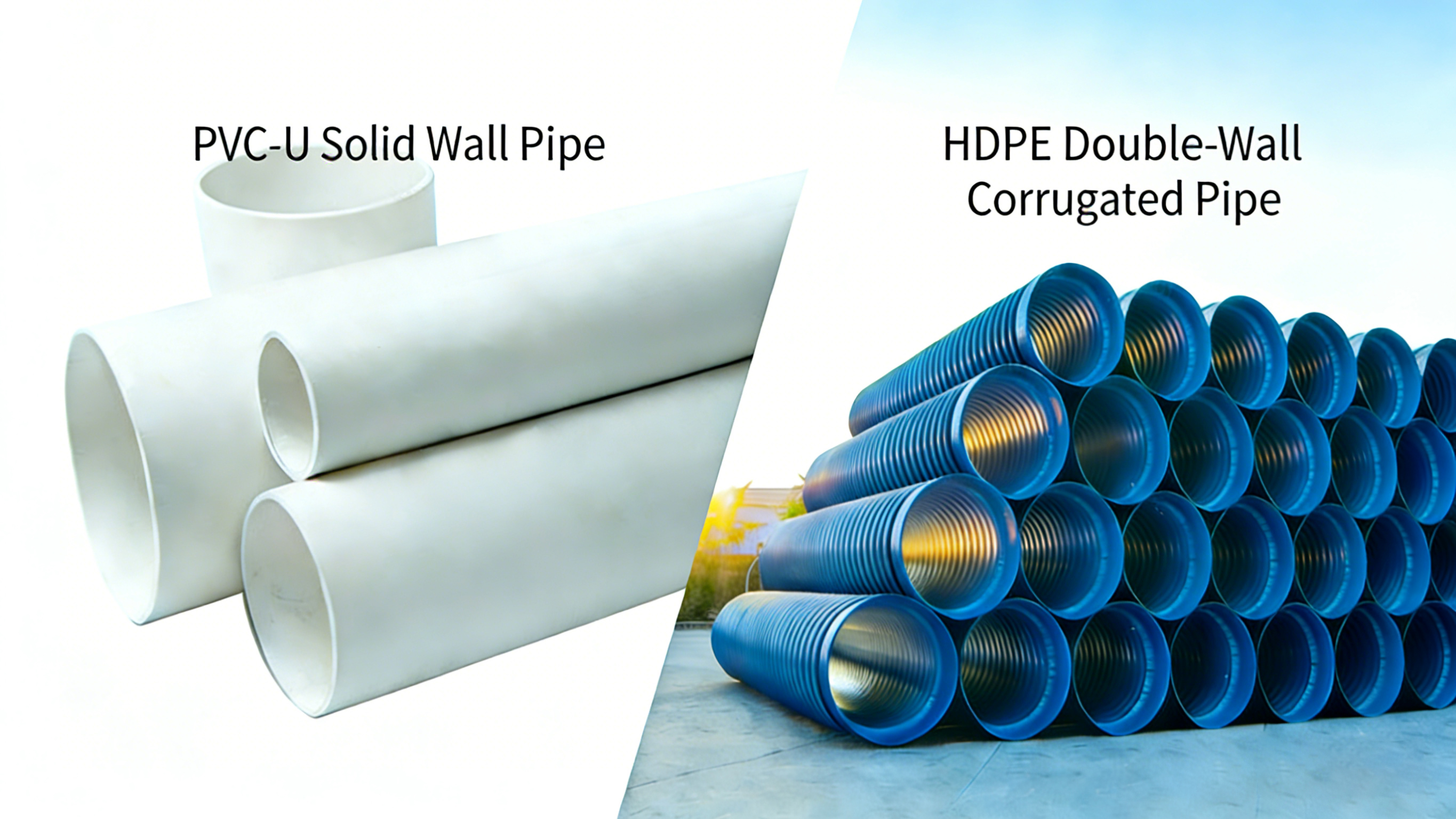
| Feature Dimension | HDPE Double-Wall Corrugated Pipe | PVC-U Solid Wall Pipe |
|---|---|---|
| Structural Characteristics | Corrugated outer wall, smooth inner wall; double-wall hollow structure. | Solid wall structure, smooth inner and outer walls. |
| Material Properties | High-Density Polyethylene, excellent flexibility. | Unplasticized Polyvinyl Chloride, relatively high rigidity. |
| Connection Method | Socket-type rubber ring seal, allows flexible connection. | Solvent cement bonding or rubber ring connection. |
| Deformation Resistance | Excellent, can withstand significant uneven foundation settlement. | Moderate, sensitive to foundation settlement. |
| Installation Convenience | High, single length typically 6m, rapid connection. | Moderate, single length typically 4-6m. |
| Flow Characteristics | Smooth inner wall, low friction, excellent flow capacity. | Smooth inner wall, good hydraulic performance. |
| Chemical Corrosion Resistance | Excellent, strong resistance to acid and alkali corrosion. | Good, resistant to general chemical corrosion. |
| Impact Resistance | Maintains good impact resistance even at low temperatures. | Notable low-temperature brittleness, impact resistance decreases. |
| Environmental Adaptability | Wide operating temperature range (-60℃ to 60℃). | Narrower operating temperature range (0℃ to 45℃). |
| Lifecycle Cost | Higher initial investment, lower maintenance cost. | Lower initial investment, potentially higher maintenance cost. |
II.Selection Strategy Based on Engineering Scenarios
Scenario 1: Areas with Unstable Soil Conditions
Preferred Choice: HDPE Double-Wall Corrugated Pipe
In soft soil areas, backfill zones, or regions with known settlement risks, the flexible structure of corrugated pipes offers clear advantages. Their ring stiffness can be adjusted per engineering needs (common grades SN4, SN8). Through “pipe-soil interaction,” they can effectively adapt to foundation deformation, avoiding joint cracking or pipe breakage due to uneven settlement.
Key Rainy Season Construction Points:
1.Installation can proceed even with high soil moisture, but backfill material moisture content must be controlled.
2.Use a sand/gravel bed to improve uniform pipe support.
3.Prioritize pipe installation and preliminary backfilling during rainy periods to avoid prolonged trench exposure.
Scenario 2: Tight Schedule with Frequent Rainfall
Preferred Choice: HDPE Double-Wall Corrugated Pipe
The socket-type rubber ring connection of corrugated pipes requires no waiting for adhesive curing, allowing for rapid installation and immediate water testing even in damp conditions. Single pipe lengths are typically 6 meters (some up to 9 meters), reducing the number of joints and improving installation efficiency.
Key Rainy Season Construction Points:
1.Implement sectional construction—backfill immediately after completing a section to minimize exposed work areas.
2.Prepare sufficient waterproof sheeting to cover excavated trenches during rain.
3.Joint inspection can be performed in the rain, as rubber ring connections are not affected by humidity.
Scenario 3: Residential Community Drainage System Renovation
Balanced Choice: Depends on Specific Conditions
For drainage pipes within residential communities:
• Main Pipes, Road Crossing Pipes: Corrugated pipes are recommended due to their better ability to handle road loads and potential settlement.
• Branch Pipes in Yards, Building Outlet Pipes: PVC pipes can be chosen for lower cost and flexible installation.
• Sections from Septic Tank Outlets: Prioritize corrugated pipes for their stronger corrosion resistance.
Key Rainy Season Construction Points:
1.Prioritize installation in low-lying areas and at critical nodes.
2.Set up temporary drainage ditches to prevent rainwater from flowing into the construction area.
3.Ensure joint dryness for PVC pipe solvent cement connections, using hot air equipment if necessary.
Scenario 4: Road Drainage and Municipal Engineering
Preferred Choice: HDPE Double-Wall Corrugated Pipe
Municipal road drainage systems endure complex stresses like vehicle dynamic loads and soil pressure. The high ring stiffness and fatigue resistance of corrugated pipes make them a more reliable choice. Their flexible joints allow for a certain degree of angular deflection, adapting to minor deformations in the road base.
Key Rainy Season Construction Points:
1.Use graded sand/gravel for backfill to ensure compaction meets design requirements.
2.Apply concrete encasement at critical road sections to enhance pipe stability.
3.Erect clear warning signs and temporary drainage facilities during construction.
Scenario 5: Agricultural Drainage and Water Conservancy Projects
Preferred Choice: Depends on Specific Needs
• Main Drainage Canals for Long-Term Burial:Corrugated pipes are recommended for long service life and low maintenance needs.
• Seasonal Field Drainage Pipes: PVC pipes can be chosen for lower cost and easy disassembly/replacement.
Key Rainy Season Construction Points:
1.Concentrate construction efforts during breaks in rainfall.
2.Establish a comprehensive diversion system to prevent upstream water from affecting construction.
3.Prioritize completion of the downstream outlet section to ensure an unobstructed drainage channel.
General Technical Points for Rainy Season Installation
Regardless of the pipe material chosen, the following key points must be observed for rainy season construction:
1. Trench Treatment
•Appropriately increase trench slope to prevent water accumulation.
•Set drainage blind ditches and sump pits at the trench bottom to promptly remove seepage.
•Re-check the bearing capacity of the trench foundation after rain.
2. Pipe Installation
• Perform partial backfilling promptly after pipe placement to prevent flotation.
• Implement rain protection measures for joint construction to ensure the connection area is dry.
• Suspend solvent cement connection work for PVC pipes during rain.
3. Backfill Quality Control
• Use permeable materials as the primary backfill around the pipe haunches.
• Compact in layers, with each layer not exceeding 20cm in thickness.
• Avoid using high-moisture-content clay for backfill.
4. Inspection and Protection
• Conduct water-tightness tests immediately upon completing each section to identify issues early.
• Establish comprehensive finished product protection measures to prevent damage from subsequent construction.
• Increase inspection frequency during the rainy season, especially for manholes and outlets.
Innovative Solutions for Special Circumstances
Under extreme rainy conditions, consider the following innovative approaches:
1. Prefabricated Modular Drainage Systems: Prefabricate complete modules (including pipes and manholes) in factories for rapid on-site assembly, significantly reducing outdoor work time.
2. Lightweight Trenchless Technology: For small-scale renovations, consider trenchless technologies like horizontal directional drilling to avoid large-scale earthwork.
3. Combination of Temporary Diversion and Permanent Systems: First install a temporary diversion system to ensure drainage during the rainy season, then construct the permanent system once weather conditions improve.
Cost-Effectiveness and Full Lifecycle Assessment
Assessing from a full lifecycle cost perspective:
• Short-Term Projects: PVC pipes have a clear initial cost advantage.
• Long-Term Infrastructure: Corrugated pipes, despite a higher initial investment, offer lower maintenance costs and a longer service life, providing better overall economic benefits.
• High-Risk Areas: Even with a higher initial cost, more reliable corrugated pipes should be selected to avoid greater losses from future repairs.
Conclusion
For rainy season drainage system installation, HDPE double-wall corrugated pipes are the more reliable choice in most scenarios, particularly in areas with unstable soil conditions, tight schedules, or where the piping system requires good deformation adaptability. Their flexible structure, rapid connection method, and excellent environmental adaptability can effectively address the special challenges of rainy season construction.
PVC pipes are more suitable for small-scale projects or internal building drainage systems where soil conditions are stable, schedules are relatively flexible, and cost sensitivity is high.
Prudent engineering decisions should be based on a comprehensive analysis of specific project conditions, long-term performance requirements, and full lifecycle costs. During the special period of the rainy season, selecting piping materials that minimize construction risks and ensure immediate system reliability is key to project success. Ultimately, the performance of any piping system depends not only on the material itself but also on installation craftsmanship that complies with specifications and strict engineering quality control.
We are not only a product manufacturer, also a solution provider, whether you have a Question or Request For Quotations, we're here to help.