WhatApp
+86-15522676451WhatApp
+86-15522676451
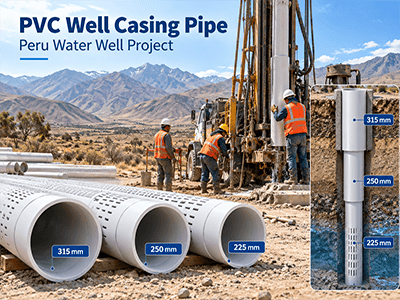
PVC casing and screen pipes perform two essential roles in a water well: supporting the borehole and controlling how groundwater enters the system. Because pipe diameter, joint design and screen configuration vary across different well projects, these products require a dedicated standard rather than the specifications used for ordinary PVC piping. DIN 4925 provides this framework for PVC‑U well casing and screen pipes, with Parts 1, 2 and 3 covering different nominal diameter ranges and threaded connections.
DIN 4925 covers solid‑wall casing pipes and slotted screen pipes manufactured from unplasticized polyvinyl chloride, commonly known as PVC‑U. Solid‑wall casing supports the borehole and isolates sections where groundwater entry is not required, while screen pipe is installed across the aquifer to allow water to enter the well.
The standard addresses more than nominal pipe size. It provides requirements relating to pipe dimensions, laying length, threaded connections, slot configuration, material properties and product testing. This distinguishes DIN 4925 well pipes from ordinary PVC pressure or drainage pipes, even when their nominal sizes appear similar.
The current DIN 4925 editions were published in March 2026, replacing the 2017 editions. Therefore, technical specifications, quotations and compliance documents should identify both the relevant part and the required edition whenever possible.
The three parts of DIN 4925 do not represent different quality grades. They cover different nominal diameter ranges and connection structures.
| Standard | Nominal diameter | Connection | Common applications |
|---|---|---|---|
| DIN 4925‑1 | DN35–DN100 | Pipe thread | Monitoring wells and small water wells |
| DIN 4925‑2 | DN100–DN200 | Trapezoidal thread | Irrigation and water supply wells |
| DIN 4925‑3 | DN250–DN400 | Trapezoidal thread | Large municipal, agricultural and industrial wells |
Selecting the correct part of DIN 4925 determines the applicable pipe size and connection system, but it does not define the complete well‑pipe configuration. Wall thickness, well depth, groundwater pressure, installation conditions and joint load must also be considered.
Solid casing and slotted screen pipe should be evaluated separately because slotting can reduce structural resistance. Slot width and open area must also match the aquifer and gravel pack to balance water flow, sand control and strength. Under the 2026 editions of DIN 4925‑1 and DIN 4925‑2, the 0.2 mm slot width is no longer included as a standard table option.
A request stating only the standard and outside diameter is usually insufficient for an accurate quotation. Buyers should also identify whether they require solid casing, screen pipe or both, together with the wall thickness, effective length, thread type and quantity.
For screen pipe, the required slot width, screen length and open‑area requirement should be stated. Project information such as total well depth, groundwater conditions, intended use and installation method can help the manufacturer verify whether the proposed pipe configuration is suitable.
Compliance should also be supported by product‑specific technical information. ISO 9001 demonstrates that a manufacturer operates a quality management system, but it does not by itself prove that a particular casing or screen pipe conforms to DIN 4925. Relevant dimensional inspections, material test results, thread checks, joint‑performance data and external‑pressure results provide more direct evidence.
For drinking‑water wells, any required hygienic or drinking‑water contact documentation should be confirmed separately. DIN 4925 product compliance should not automatically be treated as equivalent to a specific drinking‑water certification.
DIN 4925 provides a dedicated technical framework for PVC‑U well casing and screen pipes. Part 1 covers DN35 to DN100 pipes with pipe threads, Part 2 covers DN100 to DN200 pipes with trapezoidal threads, and Part 3 covers DN250 to DN400 pipes with trapezoidal threads.
Selecting the correct part is an essential first step, but the standard number alone cannot determine the complete pipe specification. Well depth, wall thickness, external load, joint strength, screen configuration and geological conditions must still be evaluated. A properly specified DIN 4925 system should therefore be selected from the requirements of the entire well—not from nominal diameter alone.
We are not only a product manufacturer, also a solution provider, whether you have a Question or Request For Quotations, we're here to help.