WhatApp
+86-15522676451WhatApp
+86-15522676451
During an inquiry for PVC well screens, slot size is often overlooked, even though it directly affects the performance of a water well. Many buyers can clearly specify the required pipe diameter, wall thickness and screen length. However, when asked about the slot size, they may simply request “the standard specification” or “the most commonly used size.”
This approach carries a certain level of risk because there is no single standard PVC screen slot size suitable for every water well.
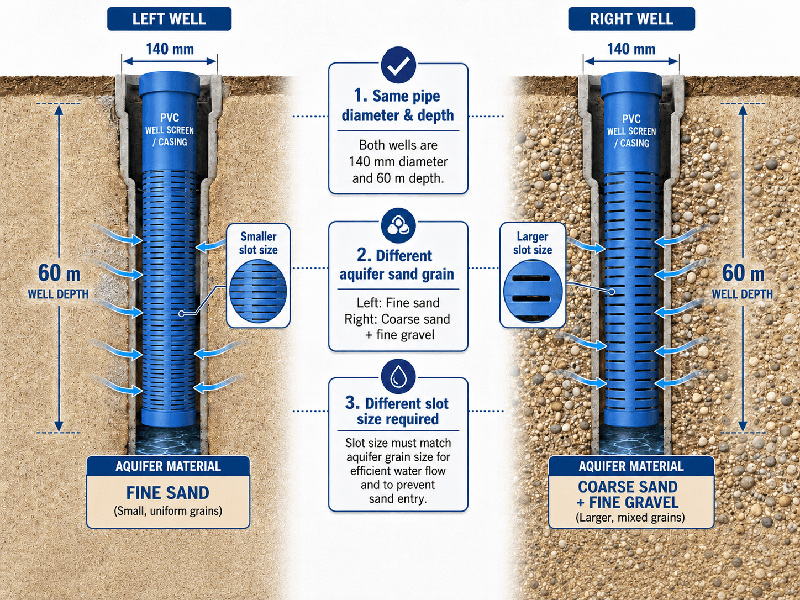
Well depth affects the external pressure and installation loads on a PVC screen, while pipe diameter relates to pump installation and water‑carrying capacity. Neither parameter indicates the size of the aquifer particles.
For example, two wells may both use 140 mm PVC screens installed at a depth of 60 metres. One aquifer may consist mainly of fine sand, while the other contains coarse sand and fine gravel. Despite having the same pipe diameter and wall thickness, the two wells may require different slot sizes.
A manufacturer can therefore provide only a preliminary recommendation when given the well depth, pipe diameter or a general formation description. Final selection requires more detailed formation information.
A reliable slot‑size selection should begin with samples from the interval where the screen will be installed. If the screen is set between 45 and 65 metres, the material analysed should come from that depth whenever possible.
Cuttings collected at the wellhead may contain materials from several formations. Fine particles can be removed by drilling fluid, while larger particles may settle as they move upward. Such mixed samples may not accurately represent the material around the screen.
When a well passes through aquifers with different grain sizes, the samples should be collected and recorded separately. Different intervals may require different screen lengths, filter‑pack gradations and slot sizes.
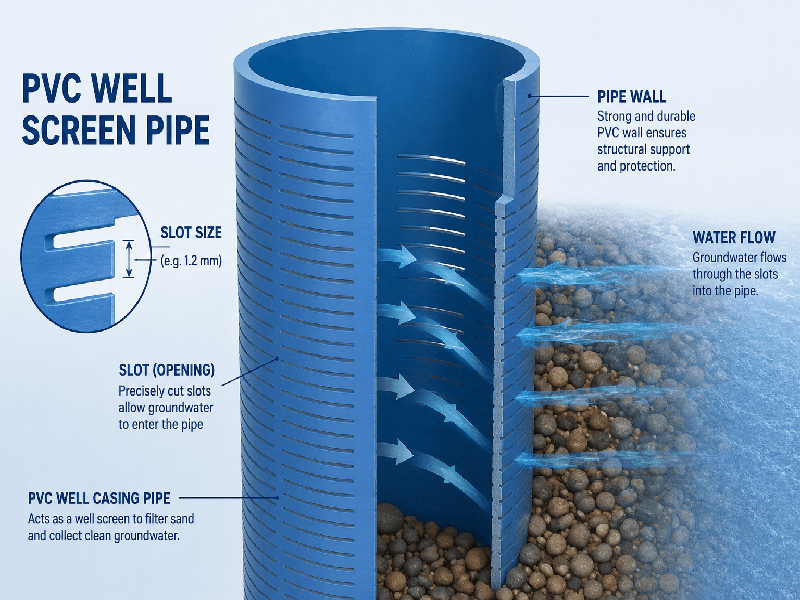
Without an artificial filter pack, a PVC well screen is in direct contact with the natural aquifer. During well development, some loose fine particles pass through the slots, while the coarser particles remain and gradually form a natural filter around the screen. In this case, the slot size should be selected mainly according to the grain‑size distribution of the formation.
The screen does not need to block every fine particle. If the slots are too narrow, fine sand, silt and clay may clog the openings and reduce the well yield. A suitable design allows some fine particles to be removed during development while retaining enough formation material to create a stable zone around the screen.
The selection method is different for a gravel‑packed well. Once an artificial filter pack is placed around the screen, the screen comes into direct contact with the filter material rather than the natural formation. The filter pack should therefore be selected according to the aquifer material first, and the screen slot size should then be determined from the filter‑pack gradation.
For example, if the main aquifer particles range from 0.3 to 0.6 mm and the filter pack ranges from 1.0 to 2.0 mm, the slot size should be chosen to retain most of the filter material. A 2.0 mm slot should not be selected simply because the largest filter particles are 2.0 mm. The finer portion of the filter pack is more important when determining the slot size.
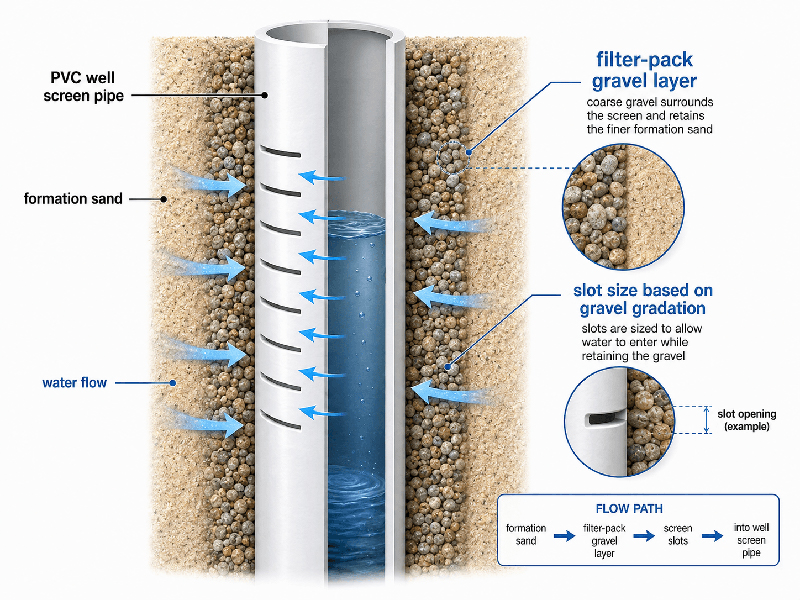
After the slot size has been selected, the screen’s overall water‑entry capacity must also be checked. Two screens may both have 0.5 mm slots, but differences in slot length and the number of slots per metre will result in different total open areas.
If the open area is insufficient, increasing the slot size is not the only solution. The screen length, number of slots or pipe diameter can also be adjusted. Larger slots may increase the open area, but they can also increase the risk of sand entering the well.
The number of slots cannot be increased without limit. Cutting slots interrupts the continuity of the PVC pipe wall. As the number and length of the slots increase, greater attention must be paid to the screen’s resistance to external pressure. For this reason, the strength data of a solid casing should not be used directly for a slotted screen of the same diameter.
The determination of PVC screen slot size should start from the aquifer itself, rather than from the manufacturer’s existing specification table. For wells without gravel packing, the appropriate retention level should be determined based on the grain‑size distribution of the natural formation. For gravel‑packed wells, the filter material should first be designed according to the natural formation, and then the screen slot size should be confirmed based on the filter‑material gradation. After obtaining the theoretical result, adjustments should also be made by considering the factory’s processing capability, slot tolerance, screen open area, and structural strength after slotting. In conclusion, slot selection is a comprehensive technical decision; the correct size is the one that suits the specific formation and well structure.
We are not only a product manufacturer, also a solution provider, whether you have a Question or Request For Quotations, we're here to help.